

Arabic poetry holds a special place in the hearts of Arabs and has been a cornerstone of Arabic culture for centuries. Known as تراث العرب (the patrimony of the Arabs), poetry is not merely a form of artistic expression; it is a reflection of the Arab identity, history, and ethos. Interestingly, during the caliphate eras, while Arabs engaged in extensive translation endeavors, bringing wisdom from Persian, Greek, and Indian cultures into Arabic, they notably chose not to translate poetry from other cultures. This decision underscores their belief in the unmatched beauty and uniqueness of their poetic tradition.
Let us explore why Arabic poetry is so integral to Arabic culture, its structure, and its various types.
The Role of Poetry in Arabic Culture
Poetry in Arab culture was, and continues to be, more than mere entertainment. Historically, it served as a repository of wisdom, a medium for recording events, and a tool for persuasion and diplomacy. During pre-Islamic times, poets were regarded as the voice of their tribes, using their verses to celebrate victories, lament losses, and criticize rivals. Poetry was recited in marketplaces like Sūq Šu‘ayr and at tribal gatherings, where it captivated audiences with its rhythmic beauty and depth of meaning.
Even in modern times, Arabic poetry remains a powerful medium. It has inspired revolutions, preserved the essence of Arab identity during colonial periods, and continues to resonate with Arabic learners worldwide.
Structure of an Arabic Poetic Verse
Traditional Arabic poetry follows a strict structure, known as البيت (al-bayt), which is composed of two halves: صدر (sadr, the first hemistich) and عجز (ʿajz, the second hemistich). These two parts are unified by a consistent rhyme and meter, regulated by rules from علم العروض (ʿilm al-ʿarūd, the science of prosody), developed by the scholar Al-Khalil ibn Ahmad.
This meticulous structure not only lends harmony to the verses but also allows poets to experiment within the framework, showcasing their linguistic prowess and creativity.
Types of Arabic Poetry
Arabic poetry is diverse, with various forms reflecting different emotions, themes, and purposes. Here are some prominent types, along with their descriptions, notable poets, and famous examples:
1. Ghazal (غزل)
The ghazal is a form of love poetry that expresses longing, admiration, and the beauty of the beloved. It often delves into the joys and sorrows of love, portraying the emotional depth of the poet. The ghazal is characterized by its romantic themes, vivid imagery, and heartfelt expressions of desire.
- Notable Poets: Majnūn Laylá, Nizar Qabbani
- Famous Verse:

“وزادني كَلَفًا في الحبِّ أن مُنِعَتْ ** أحبُّ شيءٍ إلى الإنسان ما مُنِعَا”
(“My passionate love increased when she was forbidden ** The most beloved thing to a person is that which is forbidden.”)
- Author: Qays ibn al-Mulawwah (Majnūn Laylá)
- Context: This verse reflects his unending sorrow and love for Laylá, symbolizing the torment of unfulfilled love.
2. Madīḥ (مدح)
Madīḥ is poetry of praise, often dedicated to leaders, patrons, or religious figures. It emphasizes virtues, noble deeds, and honor, serving as a testament to the greatness of the praised figure. These poems were often used to secure favor or rewards from patrons.
- Notable Poets: Al-Mutanabbi, Ka‘b ibn Zuhayr
- Famous Verse:

“إِنَّ الرَّسُولَ لَنُورٌ يُسْتَضَاءُ بِهِ ** مُهَنَّدٌ مِنْ سُيُوفِ اللَّهِ مَسْلُولُ”
(“Indeed, the Messenger is a light from which illumination is sought, ** A sharp sword from the swords of God, unsheathed.”)
- Author: Ka’b ibn Zuhayr
- Context: In this verse, Ka’b ibn Zuhayr praises the Prophet Muhammad as a guiding light and a formidable warrior, emphasizing his significance and valor. The poem “Bānat Suʿād” holds a special place in Arabic literature and Islamic history due to its profound praise and the circumstances of its recitation.
3. Fakhr (فخر)
Fakhr poetry celebrates personal or tribal pride, focusing on achievements, valor, and noble lineage. It served as a way to assert dominance and foster a sense of identity and honor, especially in tribal societies.
- Notable Poets: Antara ibn Shaddad, Al-A‘sha
- Famous Verse:

“الخَيْلُ وَاللَّيْلُ وَالبَيْداءُ تَعْرِفُني ** وَالسَّيْفُ وَالرُّمْحُ وَالقِرْطاسُ وَالقَلَمُ”
(“The horses, the night, and the desert know me ** as do the sword, the spear, the paper, and the pen.”)
- Author: Al-Mutanabbi
- Context: Al-Mutanabbi composed this verse during his time at the court of Sayf al-Dawla al-Hamdani, the ruler of Aleppo in the 10th century. In this line, he boasts of his prowess in both warfare and poetry, asserting that the elements of battle (horses, night raids, deserts, swords, and spears) and the tools of literature (paper and pen) are all familiar with his excellence. This dual mastery underscores his pride in being both a formidable warrior and a distinguished poet.
4. Hijāʿ (هجاء)
Hijāʿ poetry is satire or invective, used to mock or criticize rivals with sharp wit and cutting language. It often played a role in poetic duels and competitions, where poets sought to outdo one another with clever insults.

- Notable Poets: Al-Jahiz, Jarir
- Famous Verse:
“دَعِ المَكَارِمَ لا تَرْحَلْ لِبُغْيَتِهَا ** وَاقْعُدْ فَإِنَّكَ أَنْتَ الطَّاعِمُ الكَاسِي”
(“Leave off seeking noble deeds and their pursuit, ** And sit down, for you are merely one who eats and is clothed.”)
- Author: Jarir
- Context: This verse was part of a satirical exchange with his rival Farazdaq, showcasing his sharp tongue and quick wit.
5. Rithāʿ (رثاء)
Rithāʿ is elegiac poetry, expressing deep sorrow and lamentation for the loss of loved ones or significant figures. It captures the emotional weight of grief and the inevitability of mortality.
- Notable Poets: Al-Khansa, Abu Tammam
- Famous Verse:
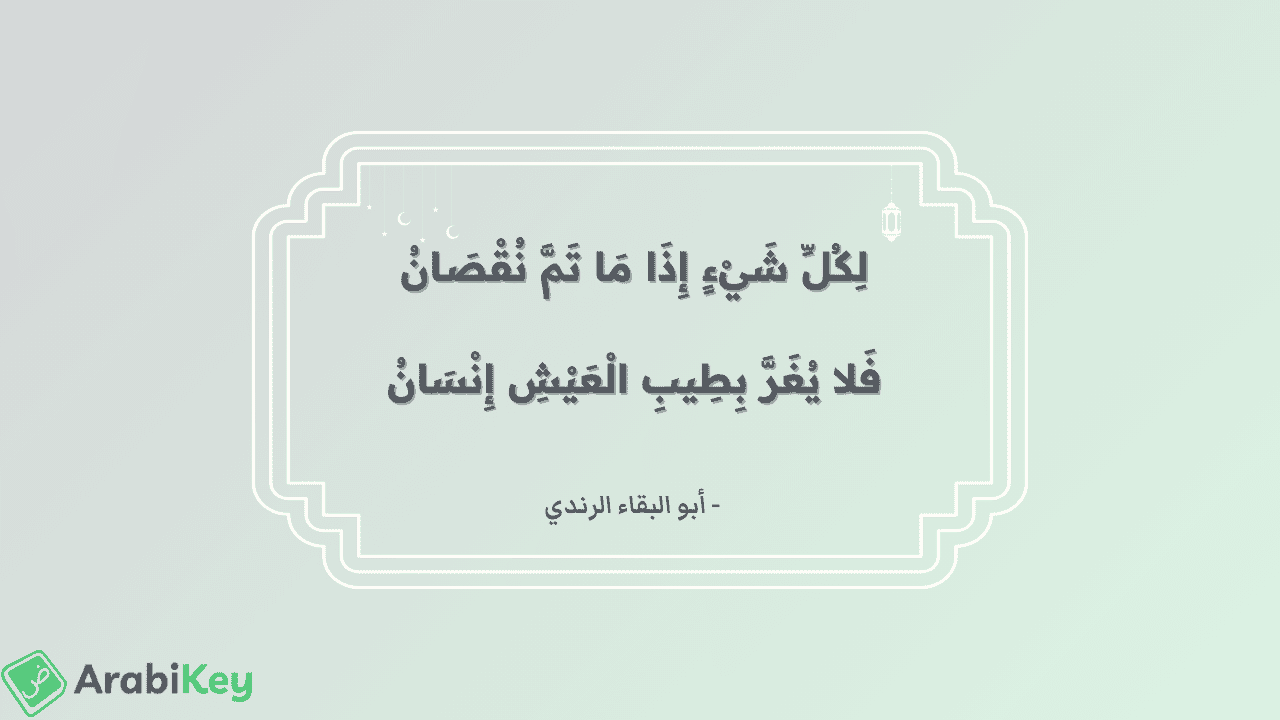
“لِكُلِّ شَيْءٍ إِذَا مَا تَمَّ نُقْصَانُ ** فَلا يُغَرَّ بِطِيبِ الْعَيْشِ إِنْسَانُ”
(“Everything declines after reaching perfection ** Therefore, let no man be beguiled by the sweetness of life.”)
- Author: Abu al-Baqa’ al-Rundi
- Context: This verse is from the famous elegy “Ritha’ al-Andalus” (رثاء الأندلس), composed by Abu al-Baqa’ al-Rundi in the 13th century. The poem laments the gradual loss of Muslim territories in al-Andalus (modern-day Spain) during the Reconquista. Al-Rundi mourns the fall of prominent cities and reflects on the impermanence of worldly possessions and the inevitability of decline after prosperity.
Modern Arabic Poetry
Modern Arabic poetry has evolved significantly from its classical roots while still retaining its essence. The advent of free verse (شعر التفعيل) in the 20th century marked a major shift, allowing poets to break away from traditional meter and rhyme schemes. This form of poetry, pioneered by poets such as Badr Shakir al-Sayyab and Nazik al-Malaika, enabled a more flexible and expressive approach, often tackling contemporary issues like social justice, freedom, and identity.
Modern poetry also saw the rise of prose poetry (الشعر النثري), which eschews all structural constraints, focusing instead on powerful imagery and emotional depth. Poets like Mahmoud Darwish and Adonis became prominent figures in this movement, using their verses to reflect on themes of exile, resistance, and the human condition.
This evolution of Arabic poetry demonstrates its enduring relevance and adaptability, making it accessible and relatable to new generations of readers and learners.
Conclusion
Arabic poetry is not just an artistic expression but a living embodiment of Arab heritage. Its intricate structure, diverse themes, and profound cultural significance make it an essential part of understanding the Arabic language and culture. As you delve into this world of rhythm and meaning, you will not only appreciate the artistry of Arab poets but also find a unique way to connect with a rich and timeless tradition.
⌨️ Practice Arabic typing with our Arabic keyboard featuring automatic tashkil/diacritization

Parler des métriques aurait été un plus. Bravo pour l’article
Bel article introductif sur la poésie arabe qui donne envie d’en savoir plus. Merci.
Hi love poetry