

The term Arabic dictionary can be expressed as قاموس (qāmūs) or معجم (mu‘jam). While both words refer to dictionaries, قاموس is commonly used for general reference, whereas معجم is typically reserved for scholarly works that classify words by their root letters.
A well-used Arabic dictionary can be a game-changer for learners and native speakers alike. Whether you’re expanding your vocabulary, verifying meanings, or improving comprehension, knowing how to navigate one efficiently makes a big difference. This guide will help you master the best ways to use an Arabic dictionary effectively.
Understanding Arabic Dictionaries
Arabic dictionaries differ from English dictionaries in structure and organization. Instead of listing words alphabetically, traditional Arabic dictionaries arrange words based on their root letters (جذر). This means that to look up a word, you often need to identify its root first.
For example, the word مُدَرِّس (teacher) comes from the root د-ر-س (to study). To find it in a traditional dictionary, you would search under درس rather than مدرس.
Types of Arabic Dictionaries
1. Classical Dictionaries
These dictionaries organize words by root letters and provide historical and linguistic explanations.
Lisān al-‘Arab (لسان العرب) – Ibn Manzūr
Lisān al-‘Arab is one of the most comprehensive and authoritative classical Arabic dictionaries. Compiled by Ibn Manzūr, it provides extensive explanations, etymologies, and poetic references, making it a valuable resource for those studying classical Arabic texts.

How to Navigate Lisān al-‘Arab
- Identify the root letters of the word by removing prefixes and suffixes.
- Find the root in the dictionary, as entries are grouped under three-letter roots.
- Scan through the definitions, which include multiple meanings, synonyms, and references from poetry and classical texts.
Al-Muḥīṭ (المحيط) – Al-Fīrūzābādī
Al-Muḥīṭ, compiled by Al-Fīrūzābādī, is a well-known classical dictionary that simplifies the study of Arabic roots. Unlike Lisān al-‘Arab, it is more concise and structured, making navigation easier for learners and researchers.

How to Navigate Al-Muḥīṭ
- Identify the root letters of the word.
- Look up the root—Al-Muḥīṭ does not follow strict alphabetical order. Instead, it assigns a number to each root.
- Use the reference number to locate the corresponding root entry, where definitions and word forms are provided.
2. Modern Dictionaries
Modern dictionaries list words alphabetically but often still require searching by root letters first.
Al-Mu‘jam Al-Wasīṭ (المعجم الوسيط)
Al-Mu‘jam Al-Wasīṭ is a balanced modern dictionary that covers both classical and contemporary Arabic. It is widely used in academic settings due to its clear definitions and inclusion of modern terminology.

How to Navigate Al-Mu‘jam Al-Wasīṭ
- Words are listed alphabetically, but the root letters still matter in defining meanings.
- Each entry contains historical and modern meanings, making it useful for both classical and contemporary Arabic.
3. Bilingual Arabic-English Dictionaries
These dictionaries allow direct word lookups and provide translations. However, their structure varies—some are root-based, while others list words alphabetically.
Al-Mawrid (المورد)
Al-Mawrid is a widely used modern Arabic-English dictionary that allows direct word lookups in alphabetical order. It is popular among learners and professionals for its concise translations and example usages.

How to Navigate Al-Mawrid
- Words are listed strictly in alphabetical order, so you can search for the full word directly.
- Some entries provide both Arabic and English meanings along with example sentences.
Hans Wehr Dictionary
The Hans Wehr Dictionary is an essential tool for Arabic learners, especially those studying Arabic morphology. It organizes words by root letters, making it useful for understanding word formations and derivations.
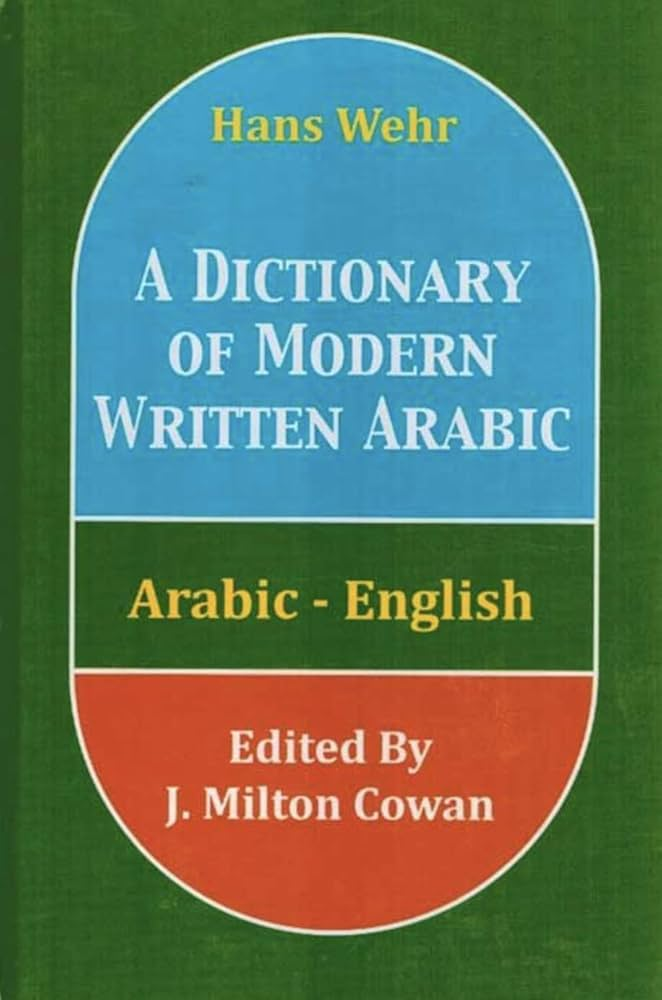
How to Navigate Hans Wehr Dictionary
- Identify the root letters before searching.
- Look up the root rather than the full word—entries are organized by root forms.
- Once the root is found, browse the derived words listed under that root.
4. Online & Digital Dictionaries
These offer fast translations, audio pronunciations, and contextual examples.
Reverso & Almaany
Reverso and Almaany provide detailed translations, synonyms, and contextual examples, making them useful for both beginners and advanced learners.
Almaany is particularly notable as it functions both as a monolingual Arabic dictionary and a bilingual dictionary with multiple language combinations involving Arabic. Additionally, Almaany offers a mobile app that allows users to search for words on the go.


How to Navigate Reverso & Almaany
- Type the Arabic or English word into the search bar.
- Browse through translations, synonyms, and contextual examples.
- Use filters to refine searches for specific meanings.
Google Translate
- Enter a word in Arabic or English to get an immediate translation.
- Use the audio pronunciation feature if needed.
- Verify accuracy by checking multiple sources.
Steps to Look Up a Word in a Root-Based Dictionary
- Identify the Root Letters – Remove prefixes (e.g., مُ, أ, ت) and suffixes (ة, ين, وا).
- Locate the Root in the Dictionary – Arabic dictionaries are arranged by root letters, so find the three-letter root.
- Find the Word’s Form – After identifying the root, search for your specific word’s form under that entry.
Using an Arabic-English Dictionary
For learners who are not yet comfortable with root-based searches, Arabic-English dictionaries provide direct word lookups. Some recommended dictionaries include:
- Hans Wehr Dictionary (root-based, excellent for Arabic learners).
- Al-Mawrid Dictionary (direct word search).
- Google Translate & Almaany (quick online lookup with examples).
Tips for Effective Dictionary Use
- Learn Common Roots: Many Arabic words derive from the same roots, so recognizing patterns will speed up your searches.
- Use Context: Arabic words often have multiple meanings; check example sentences to find the right usage.
- Combine Digital & Physical Dictionaries: Online tools are faster, but traditional dictionaries provide deeper explanations.
- Practice Regularly: Looking up words frequently will help reinforce vocabulary and improve comprehension.
Conclusion
Mastering the use of an Arabic dictionary is an invaluable skill for learners and advanced speakers alike. By understanding root-based organization and using a combination of traditional and digital tools, you can enhance your Arabic proficiency and deepen your understanding of the language.
⌨️ Practice Arabic typing with our virtual Arabic keyboard featuring automatic tashkil/diacritization

